
Thinking in academic systems
It is a formality that does not really matter. But we should not change it, or else chaos is upon us!

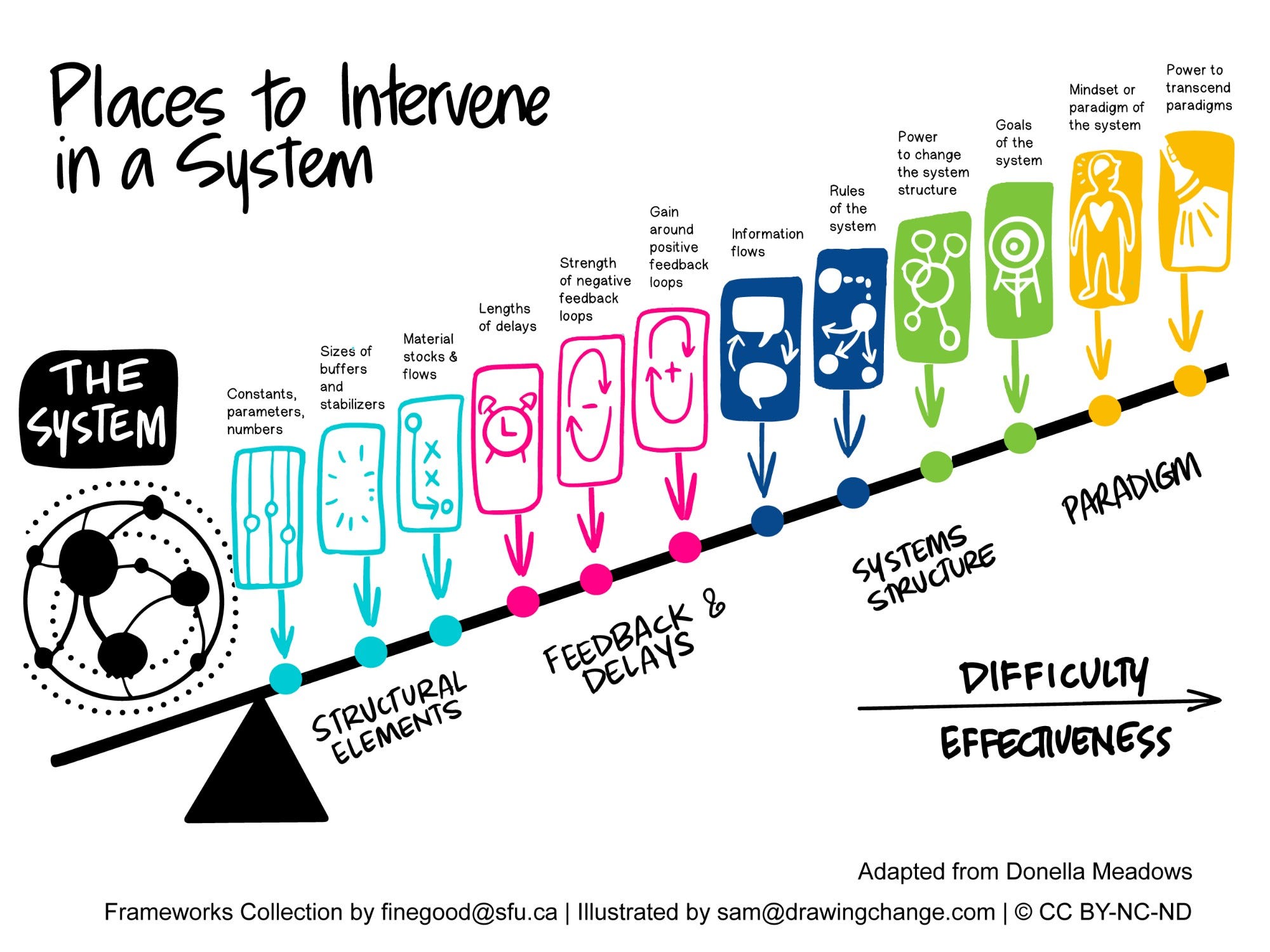
Donella Meadow’s “Thinking in Systems”, has been one of the most impressive books that I have ever read. I wish I had read it earlier. That would have saved me a lot of frustration for not understanding seemingly irrational things, like addiction, conformity, or ultra-competition.
One of the most interesting chapters is chapter 6, which is based on this original essay. In this essay Meadows categorises the leverage points for intervening in a system, to change its dynamics. She also presents a heuristic ordering of the effectiveness of applying changes at each point, and also potential effectiveness (for better or worse).
I read the book in 2023, when I was involved in designing a new national climate research institute with the mission to conduct research with impact in a timely manner. Our assignment was to create the institutional foundation for developing science-based effective remedies for tackling climate change, faster than it escalates. We soon realised the complete system of choosing projects and funding research must be revisited. Meadows’ leverage points was a very powerful reference for guessing the effectiveness of each presented strategy.
It has since become a fun exercise for me, each time I see a policy intervention, to guess which of Meadows’ leverage points would the policy correspond to. Here are a few examples of this fun exercise in the context of reforming the academic system.
Gender-specified positions
We all know that the academic population in STEM fields has a gender balance issue. This is especially a big issue for the universities in the Netherlands. Despite a historic imbalance, since 2015 on average the same number of women and men obtain PhDs in the Netherlands (source - Rathenau). At the end of 2023, the share of women full-professors was 28.7%, lowest in Europe. In their 2022 monitoring report, the Dutch network of women professors had predicted, to reach gender parity for full professors in 2041. In its last report (2024), however, this expectation has been adjusted to happen in 2044. Despite the relatively stable growth of this ratio, year by year, the target seems to be moving away.
One of the common interventions, although not the only one, to tackle the gender disparity is creating dedicated positions for women. I would categorise this as adjusting the input parameters, which has the lowest rank of Meadows’ leverage points. I am therefore not surprised that it will act very slowly. On the other hand, the gendered reasons for leaving academia act as a negative feedback loop that has a high leverage according to Measows.
“Overall, women are more likely to leave academia and have less chance of promotion than men at every age and stage of their careers. Notably, the reasons for attrition are gender-related, with women feeling more pushed out of their jobs and less pulled toward better opportunities than men.
These significant gendered differences in attrition over a career imply that even cohorts initially hired with gender parity will become progressively less diverse as they age. The researchers project that a hypothetical gender-equal cohort would decrease to 48.2% women after 15 years, 45.4% after 25 years, and 40.6% after 35 years.
Furthermore, the study reveals that the reasons for leaving academia are also gendered. Women who left academia most often reported factors related to workplace climate, such as dysfunctional departmental culture or leadership, harassment, or a sense of not belonging. In contrast, men most often reported leaving for professional reasons, such as obtaining research funding, salary, and poor administrative support.” (source LNVH)
Everyone professor
The second example is about the right to confer doctoral degrees: “ius promovendi”. Unlike many other countries where this right is set by a national law, in Dutch universities, granting promotion rights to each principal investigator is reserved for a special university council. Until recently, only full professors were automatically granted this right, even if they were appointed on an endowed (part-time) basis.
Two years ago, with the Young Academy campaign: Everyone Professor! we suggested that all university lecturers (ud), senior lecturers (uhd), and full professors should have an equal right to using the title of professor, wearing a professorial gown, and conferral right for doctoral degree (ius promovendi). Our main argument (there are more!) was that these groups largely have the same responsibilities towards the PhD researchers they supervise, so it is only fair and desirable that they also have equal rights.
For adopting “Everyone Professor”, each university had to change their rules. According the the Meadows scale, changing the rules is an intervention at a high leverage point. We knew this could cause disruption because, in the past, granting this right has been utilized in various ways and for many purposes, which we anticipated and addressed.
In response to the Young Academy campaign, most universities changed their rules (hurray!) However, each chose a different subset of our proposed adjustments (bummer!) The overall reaction of the community to these changes has been positive, as far as I can tell. However, the inconsistency at the national level has undermined the purpose of creating such a qualification and adding to the noise-level and bureaucratic burden, instead of creating an effective standard.
In practice, these varying rules are confusing people. For example some universities refuse to accept professorships from other universities as a legitimate quality criteria for promotion committees or do not allow them to wear a professional gown in their ceremonies.
This much disruption is also an effect of touching a high rank leverage point. Interestingly, Jay Forrester (founder of system dynamics) refers to this effect in quotation that also appears in Meadows’ essay:
“Time after time I’ve done an analysis of a company, and I’ve figured out a leverage point — in inventory policy, maybe, or in the relationship between sales force and productive force, or in personnel policy. Then I’ve gone to the company and discovered that there’s already a lot of attention to that point. Everyone is trying very hard to push it IN THE WRONG DIRECTION!”
In my opinion, for the leverage point of “ius promovendi” to still be effective in the future, there should either be some leadership for harmonising the rules nationally, or the community may collectively let go of the significance of this entitlement through self-organization.
Strategic personnel planning
The final example of this newsletter is by itself a new procedure and thus an intervention at high leverage points of changing the rules and codifying the goals of hiring and promotion. As mentioned in the roadmap for Recognition and Rewards in practice, the strategic personnel planning (SPP) is an instrument for realising the goals of the program in all the universities and participating institutions of KNAW and NWO.
In this plan, departments and other organisational units describe the talents they need in order to realise their vision and mission. Diversification is key in this respect. They also indicate what they expect of employees with regard to their contribution to the collective. In addition, we will determine how the contribution to the collective will be rewarded and how this fits into career policy.
Instead of the instrument itself, here I would like to focus on another high-level leverage point: The information flow. In my experience, the information channels at the university are often taken for granted to be matching the supervisory line. Ask your dean a detailed question, and most probably you will hear in response: “your supervisor can tell you.”
This might work pretty well in a nurturing work environment. In a controlling environment, however, the one-directional flow of information could cause unnecessary suffering on the workfloor and be quite misleading for the upper management, even despite the best intentions. Donella Meadows aptly describes why:
Missing feedback is one of the most common causes of system malfunction. Adding or restoring information can be a powerful intervention, usually much easier and cheaper than rebuilding physical infrastructure.
Deliberately designing the information flow can also be an effective strategic tool. For example, opening up the SPPs to be visible for all employees of a department, instead of only the management board, can result in faster alignment between personal motivations and institutional goals.
Vrij Universiteit Amsterdam seems to be setting a unique example in choosing this path. Here is their process description that I could find on their website with a simple search (unlike most other universities):
Strategic Personnel Planning consists of a number of steps: a picture of the future perspective, an analysis of the current situation and a plan to achieve the desired future situation. For a good outcome, it is important to look at ambitions, team composition and expected developments from different perspectives. That is why you usually go through SPP with a number of managers of a department or unit, under the guidance of the HR Advisor.
The curious reader may choose to search for the SPP procedures of their own organization. Or perhaps ask for the specific SPP of their own unit, institute, or department. Are they accessible to (temporary) employees? How regularly are they updated, and how transparent is the process?
Even for individual employees, demanding transparency is by itself an intervention at the information flow leverage point. Would you like to try it?